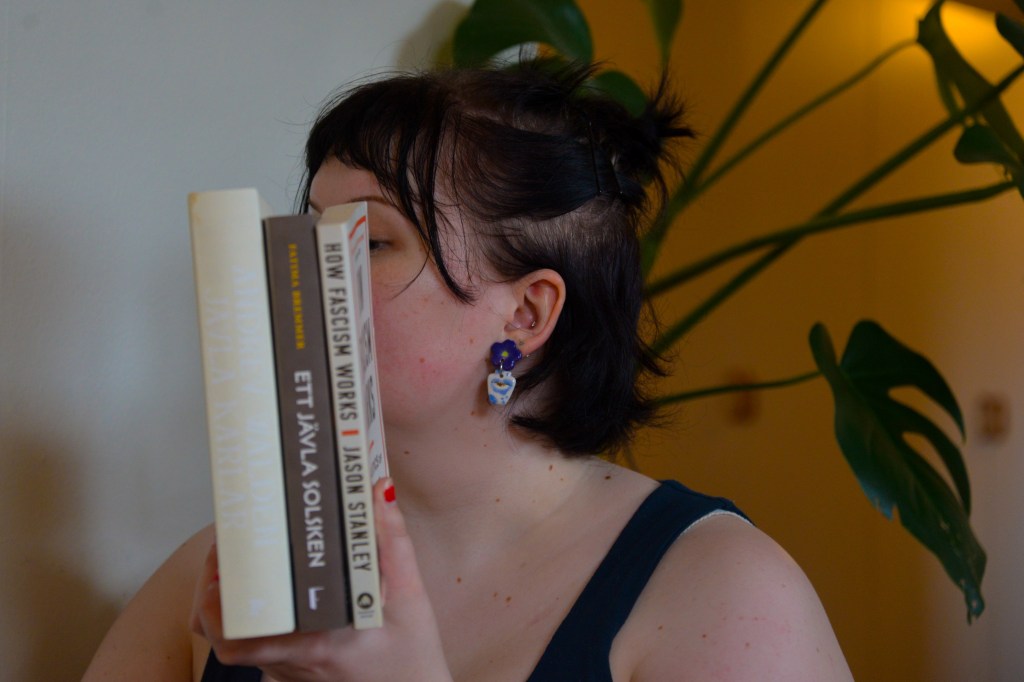
Thoughts on the inherent anti-intellectualism of social media.
”why are the pages so filled with so many words?”
A young woman is holding up a book, exuding an aura och confusion and annoyance. The book is no bible, but presumably not an ”easy beach read” either. The woman in question is an influencer, and the widespread reactions this TikTok video receives primarily stem from the fact that her niche on the platform is reviewing and recommending books. The reactions do vary: from some men finding it a great opportunity to call women as a whole stupid, to critiques of the woman within the context of her semi-professional role as a book-influencer, to people coming to her defence.
Earlier this year, during a fairly short time period, several influencers on ”book-tok” posted videos complaining about reading – which inevitably resulted in discourse around literature and the purpose of reading. Some of the creators admitted to skipping whole paragraphs of books and just reading dialogue, others said they were not interested in character backstory or motivation – only of action. Most of these creators were also women.
As mentioned, some people immediately shouted ”haha, woman dumb” at the video, others had more balanced criticisms of people being book-influencers while disliking reading. But all people who levied criticisms (ish) were lumped together, and then in turn received backlash to their backlash (I know, right). Critics who weren’t outright misogynists were deemed pretentious snobs gatekeeping literature as a high society past time.
I have several thoughts on both the reactions and counter reactions, but most can mostly be summarised within the broader categories of misogyny and anti-intellectualism.
Misogyny
I don’t want to harp on the misogyny too much, nor do I want to engage in making fun of the influencer-women in question. It’s also no coincidence that the people doing the hardest labour on that from are men. Insults were lobbied at the influencers, calling them stupid, shallow, and generally mocking their intelligence and appearance. This charade reproduces the historic idea of literature as an artform women can’t fully grasp the complexity of.
World wide, about 86 percent of people over the age of 15 are literate. Amongst men in this age group the percentage jumps to 90, and amongst women in the age group it’s 83. The highest gender gaps are observed in middle and northern Africa, in west Asia (or, the middle east), as well as a few countries in southeast Asia and south America. In the USA, there is no measurable gender gap in literacy rates, but because most of Tiktok-content is produced the American context I will focus my historical thoughts on gendered reading there.
In the early days of colonial America literacy was among the highest in the world. Neil Postman details this in his 1980 book: Amusing ourselves to death. Between 1640 and 1700 around 89-95 percent of men in Massachusetts and Connecticut were literate. The literacy among women in those same colonies are estimated to have been around 62 percent during the late 1600s – which was high at that time. The early colonial American socitey prided itself on education and reading.
- We might even say that America was founded by intellectuals, from which it has taken us two centuries and a communications revolution to recover from (p. 41).
The assertion of Postman’s book is basically that the television revolution has made the American population less intelligent, because consumption of it requires less critical thought than text, and because it contains less complex forms of information. Whether or not you completely agree, I believe Postman would’ve had even more, and much harsher, things to say about the digital media of today.
Women have always been less literate than men, simply because power and decision making was a pastime men shared exclusively amongst themselves. Denying women the equal access to education has made the historic belief that women are less intelligent than men a self fulfilling prophecy. But in the 21st century, though women are still slightly less literate than men globally, women in countries where literacy rates are equal gender-wise (there are no specific datasets for gender-non-conforming people) enter university at the same rate, or higher, than men. Women are intelligent and complex, which proves true when access to education is equal/equitable. Still, women in general are ridiculed about their intelligence more often than men in mainstream media.
On social media platforms like TikTok, women have been leading the charge in promoting books and reading. But now, they have been found out. They’re reading low quality books, and beyond that they’re skimming these low quality writing, and complaining about the amount of words in the page. This is naturally, and once again, determined to be an effect of the entire gender’s inferior intelligence. Surely, there are no larger structural problems on the internet that might lead these ladies to skim books and read low quality writing. Right?
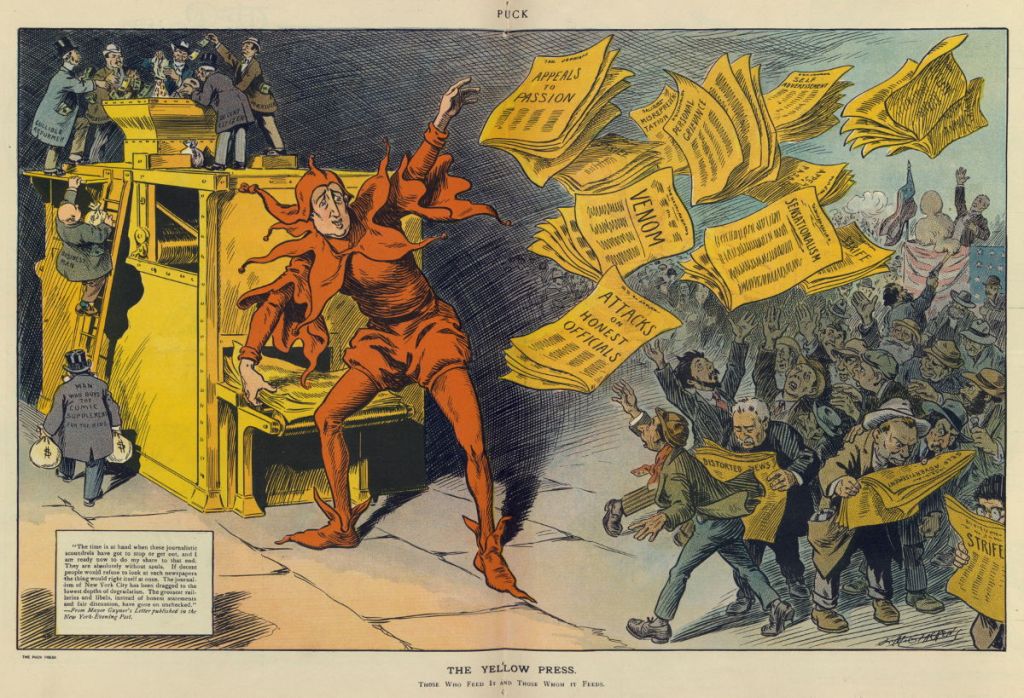
Social media as medium
The social media economy demands that influencers produce content, often, that keep viewers attention. As the consumer, your time is currency, and the more of it you give of it – the more the influencers you give it to are rewarded. Either algorithmically or monetarily, or both. Your critical thinking skills are not required for consumption, and if applied might actually risk disrupting your engulfment of video after video. Therefore, social media content is not generally meant to be thought about, just reacted to – and left behind.
Returning to Postman, his book presents the theory of medium as metaphor. It’s a semi-convoluted concept that Postman continuously constructs throughout a whole book, but I will attempt to use its basics to explain the social media landscape. The idea is this: we cannot imagine what we cannot think, and we cannot think what we are unable to communicate; therefore, our tools of communication define the scope of our ideas. Postman uses a very material example to demonstrate this:
- We can assert that human eye-vision is improvable because we have eyeglasses that improve vision. Without the tool (eyeglasses), and before the tool existed, we would find it hard to thoroughly communicate the concept of vision-improvement, simply because there would be no reason to believe in it.
My understanding of what Postman is trying to convey is basically that the tools through which we communicate dictate what we are able to say, and therefore, in extension, what we are able to think. I’ll describe how this applies to social media platforms next.
Tiktok is a short form visual content platform, therefore creators on it mainly communicate through short bursts of information that is easy to digest. Competing for your attention, the bursts are also, usually, pretty intense. To make information fit within this format only the most interesting or attention-grabbing parts of it can be said, and complexities naturally have to be scaled back. One short video, after the other, exploding into our faces, full of attention-grabbing but meaningless information, lacking nuance. Over time, acquiring information in this way affects the way we think and how we ourselves communicate.
Postman describes that in the late 1700s, foreigners who visited the American colonies remarked on their way of speaking. Because the culture highly regarded reading, and the population were both largely literate and avid readers, they spoke in a sort of ”printed orality”. The French writer Alexis de Tocqueville remarked:
- An American cannot converse, but he can discuss, and his talk falls into a dissertation (s. 42).
At that time, oral American english was modeled on the novel, people spoke at length to an invisible audience instead of partaking in the back-and-forth conversation we’re used to. Postman observes a point in time where the dominating medium of communication impacted the way people talked. If we apply Postman’s observations of medium as metaphor on today’s main communicative medium, social media, we might imagine several consequences to our real-life conversation and thought.
Because short and less nuanced forms of communication are dominating social media, our minds are adjusting – thoughts are consequently becoming shorter and less nuanced. This will probably affect both verbal and literary communication, as well as what we do. When we read, we skim the paragraphs – the nuance – to get to the dialogue – the straightforward and easily digested. When we pass information on, we strip the nuance to get to the point. Through this lens, the fact that the women of book-tok are engaging in these behaviours is not surprising or unique, it’s a symptom of the effect social media is having on all of our minds.
”We cannot imagine what we cannot think, and we cannot think what we are unable to communicate.”
Communication through the very limited medium of social media constrict our thoughts and imagination. Continuously deconstructing our ability to challenge norms, think critically, and reason in nuanced ways. It’s not surprising that influencers on ”book-tok” skim literature or skip paragraphs, nor that they recommend the same few books, or that those books are ”easier reads”. It makes complete sense for the TikTok format. While it’s easy to blame the creators, that may in and of itself be a symptom of the nuance-deficiency social media is inflicting on our minds. Examining the culture and medium it exists in, questioning social media and its effect on us, is undoubtedly harder – and more pretentious – but it has to be done.

Anti-intellectualism online
Through these observations of media as metaphor, it becomes clear that anti-intellectualism is at least somewhat inherent to social media platforms. In 2025, it’s also promoted by many governments – not least by American authorities, where a huge amount of influencers are located. While the serious state of these political landscapes can’t be examined within the confides of this essay, it’s worth noting that this likely has some additional effect in shaping the minds of people growing up today.
Online, we are stuck in a spiral of anti-intellectual content creation, exemplified here by book-tok. The content is anti-intellectual (as in being un-nuanced and encouraging consuming over thinking), which manifests through which books are being promoted, and in extension within the books themselves.
I’d like to describe the content produced on and for book-tok as ”slop”-adjacent. In this context, slop is a descriptive word for low quality digital content – specifically when it’s characterised by lack of effort, quality, and meaning.
I won’t call all of book-tok low quality slop, but there are parts of it both teetering on and falling over the edge of being slop-content. I find it especially interesting that the low effort online content, where books aren’t even fully read before reviewed and recommended, breeds low effort content within the books that are being reviewed. As it’s beneficial for the TikTok-creators to review ”simpler” books, there is also a larger (financial) incentive to create them. Authors are made aware that they don’t have to, and maybe even shouldn’t, put massive effort and thought into their works. Writing a book with recognisable tropes, juicy sex-scenes, and action-packed dialogue might be enough to make it a huge commercial success – thanks to book-tok. Why work hard, under insecure financial conditions, to make a masterpiece that no-one wants to read? Instead, you could serve up some quick and hot slop and make enough money to pay rent.
This creates a declining spiral in quality, where both the reviews and books become sloppier over time, meant only to be uncritically and mindlessly consumed – never thought about. This creates a very weird literary climate, where people are consuming more books than before, but simultaneously might be reading them less. In turn, there are more sloppy books created, which oversaturate the market and make it generally harder for authors to aim for quality over quantity. Not everyone can be Stephen King (a famously fast but quality writer).
With this context in mind, I find it fairy reasonable to criticise both the creators and books of book-tok. People are maybe allowed to be a bit pretentious, to think something is bad and saying it. In our current times we’re all subconsciously being encouraged to think less and consume more. This needs to be challenged, even if the criticism is received as a bit self important. We need to challenge both which types of communication (information) we receive and what we in turn communicate back. Keep on diversifying our communicative toolboxes and in extension our minds. Then we might teach our brains to appreciate the process of reading something difficult, and find gratification in following through on longer-term investments – rather than in instant hits of dopamine.
To be clear, gatekeeping literature as an exclusively and uniquely intellectual will not solve any problems. Literature is supposed to be both accessible and enjoyable. But being a complacent consumer is not the answer either – I would hate to see us become the Wall-E people. You can definitely read slop-books if you want, but maybe take some time to think about the why, and how to approach reading more intentionally. Care more about your hobbies, be a bit more pretentious about what you’re reading, or watching. Try to not consume books the way we consume social media content – so famished for the next thing you barely care about what’s in front of you.
Text: Hanna Williams


Lämna en kommentar